Loading story...

Modern Thirst
As told by
Plinio Guzman
Photos by
Benji Soto
The race to repair fragmentation
November 1, 2025
The race to repair fragmentation
November 1, 2025
Loading story...
Loading story...
He parts the tule with his forearms and leans toward the edge of Poza Churince. The reeds brush his shoulders. The lagoon has not vanished yet, but it has narrowed.
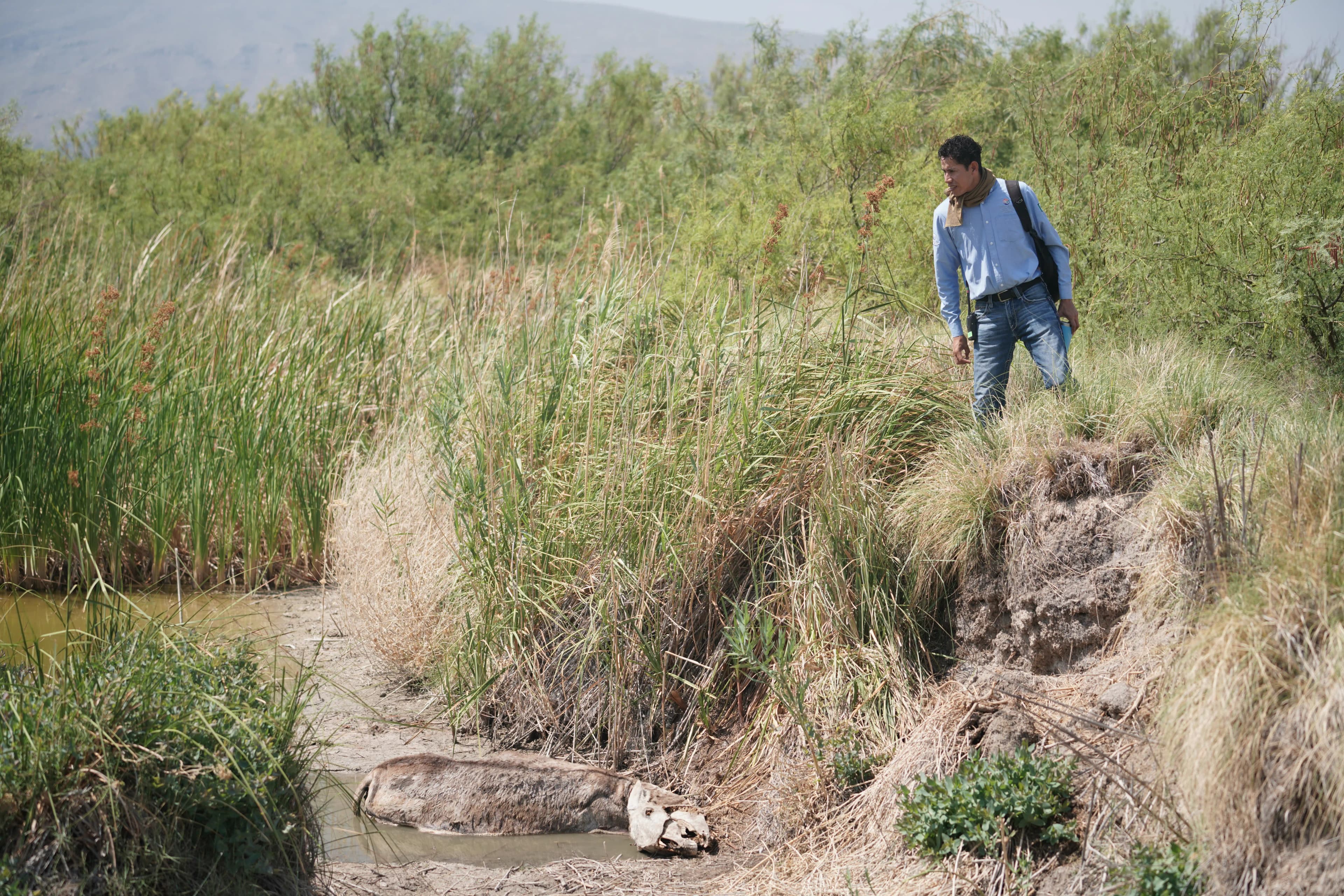
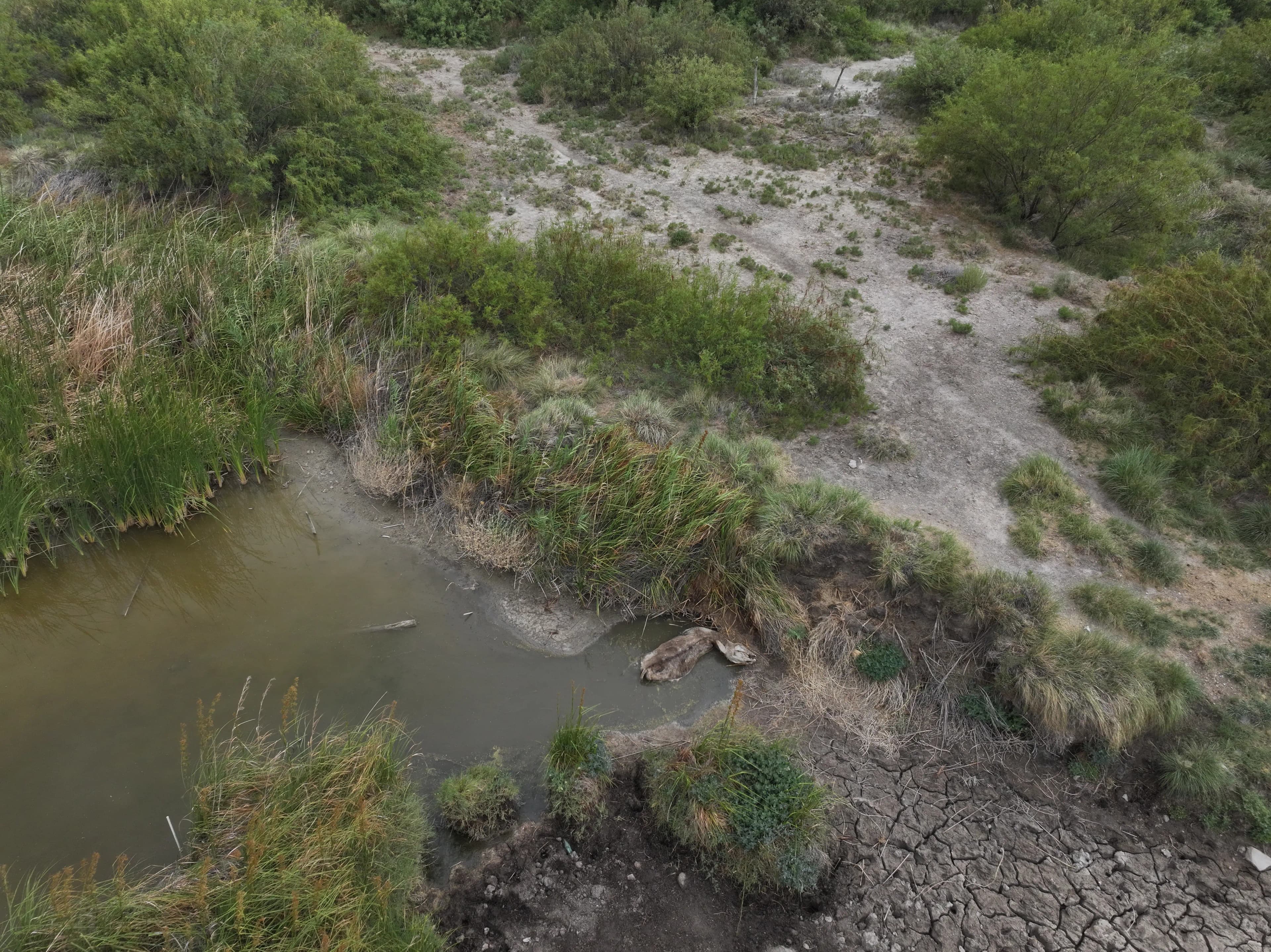
In the shallows lies a dead donkey, half decomposed. It does not explain the place. It does not belong to the life this water once held together. That is what makes it difficult to ignore.
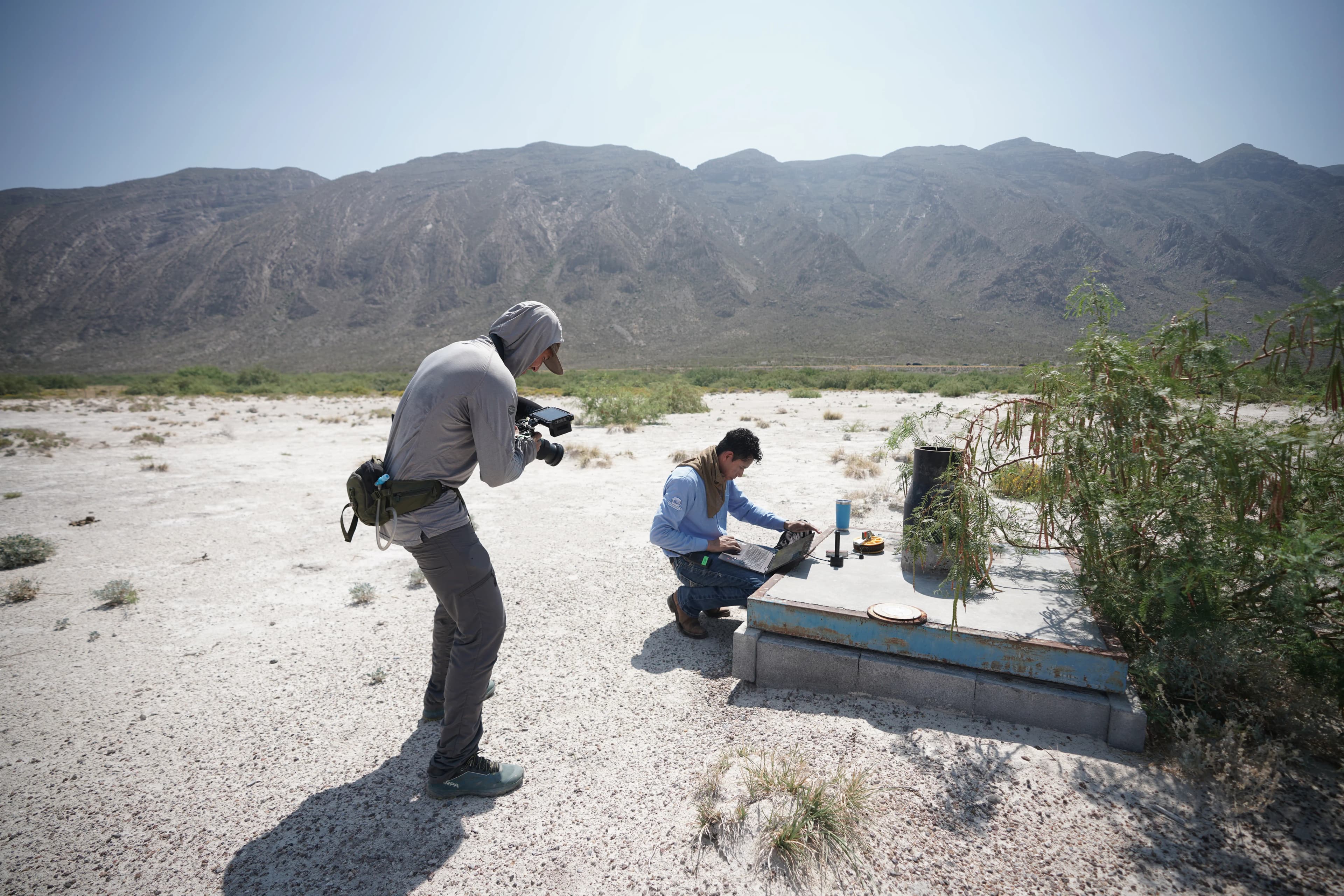
Fernando turns from the shore and cuts through thorns toward a narrow pipe sunk into the ground. He unscrews the cap, lifts out a piezometer, and plugs it into his laptop. The line appears on the screen: the water has dropped only a few centimeters since last month.
Almost anywhere but here, that would seem insignificant.
"At Churince, centimeters matter," Fernando says. "A few can mean the system is moving underneath."
From above, Cuatro Ciénegas looks scattered: springs, marshes, blue pools broken across the desert floor.
They do not, however, work in isolation.
Beneath the basin, water moves laterally through limestone and porous rock, tying one spring to another through hidden pathways. A drop in one place can register elsewhere. A weakening edge can belong to a larger loss already in motion.
That is why Churince matters. Not because it is the only place changing, but because it shows change early. The basin does not fail all at once. It begins by thinning at the margins.
In 1995, National Geographic photographed this desert when Churince still held far more water. We returned to find those same vantage points and make the comparison ourselves. The delta is not abstract. It sits in the frame: less blue, less continuity, less life held together than before.
Cuatro Ciénegas was shaped by slowness.
Over immense spans of time, geology isolated the basin and gave water a narrow set of pathways, pressures, and balances. Chemistry stabilized. Flow settled. Life adapted to those conditions with unusual precision.
That precision made the basin fertile for rare forms of life. It also made it vulnerable.
Systems built over deep time do not absorb abrupt disturbance gracefully. When extraction, diversion, and warming begin moving faster than recharge and distribution can answer, the basin does not snap. It frays.
Collapse here does not begin with spectacle. It begins with readings, interruptions, partial recoveries, then a settling below where things once were.
Fernando runs his finger over the graph on his laptop. The line is not dramatic. It is worse than dramatic. It is plausible.
“We always want a clear threshold,” he says. “But the basin doesn’t always fail in a way people can recognize right away.”
Water on the surface can still look present while the conditions that keep it moving as a basin begin to fail. Fernando returns the instrument to the pipe and tightens the cap. He is not here to confirm an ending. He is here to find what might still be held.
If the chain of collapse is distributed, any repair will have to be distributed too.
Cuatro Ciénegas is not disappearing in a single event.
It is thinning. Hydrologically. Geologically. Biologically.
No single reading can say where the point of no return lies. No single gauge can say when a basin stops functioning as a whole. What is uncertain is not whether change is happening. It is whether recognition will arrive in time to matter.
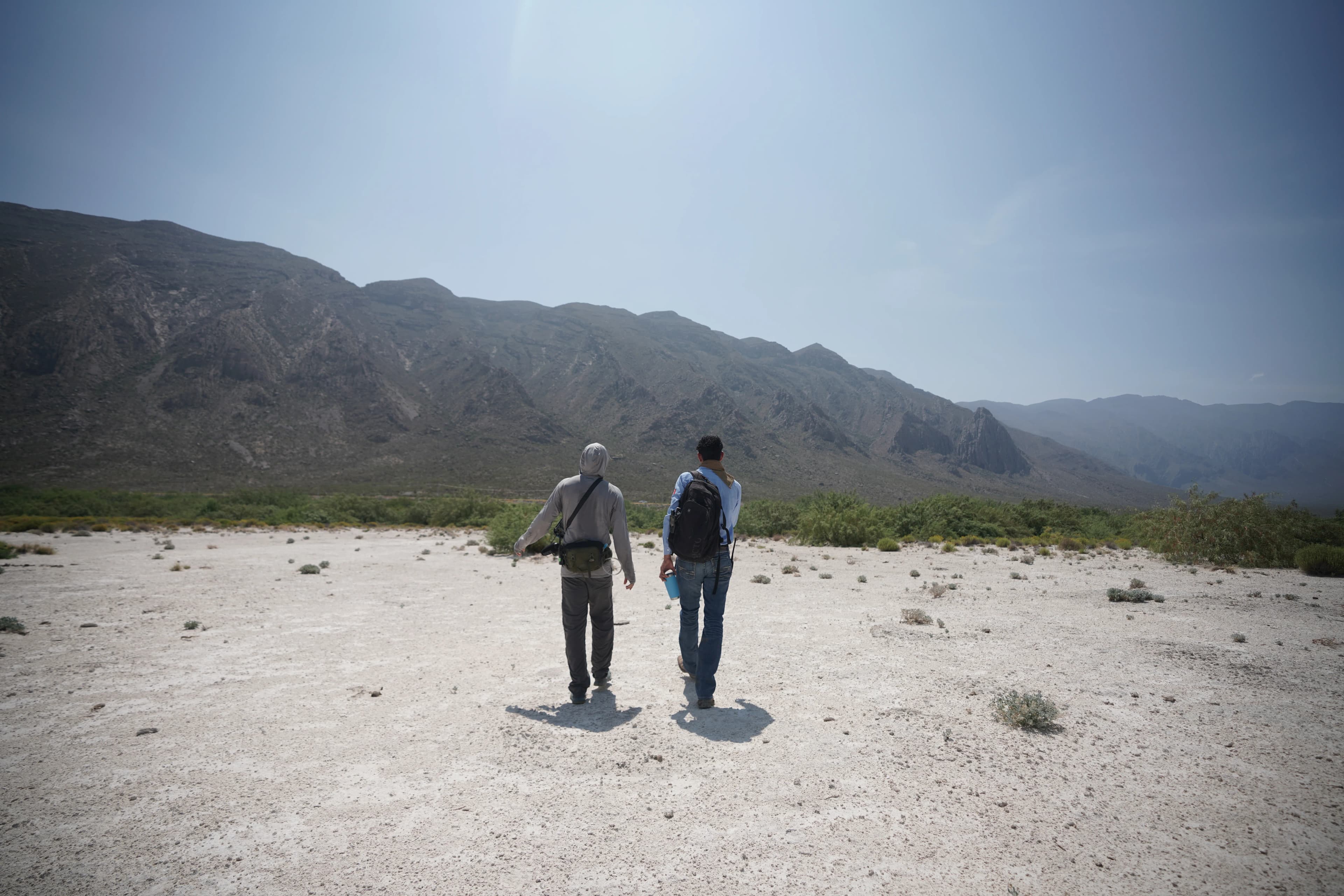
Fernando pushes back through the thorn scrub toward the road. Behind him, Churince remains under the hard afternoon light, still present, still measurable, and already less than it was.
From above, the basin leaves another kind of record. One written in decades of pixels, where slow loss gathers into view.
Photo Gallery